
 ECCE Europe 2026 is an unparalleled platform for networking, collaboration, and knowledge exchange among leading professionals, academics, and researchers from around the globe. The technical programme is designed to showcase the latest developments, research breakthroughs, and emerging trends in energy conversion. ECCE Europe 2026 included a range of sessions, including high-quality plenary speeches, keynote presentations, tutorials and an exciting exposition.
https://www.ecce-europe.org/2026/
Emmanuel Sule presented the paper: “A Two-Stage Morris-Sobol Framework for Assessing Converter Control Impact on DC Grid Protection Design” (Emmanuel Eragbe Sule, Abolfazl Mohammadi, Xiaoxiao Liu, Geraint Chaffey, Dirk Van Hertem)
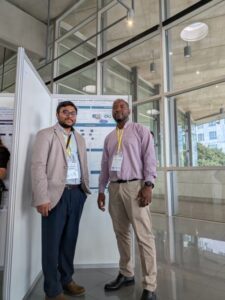 The work applies a two‑stage global sensitivity analysis framework to assess how Modular Multilevel Converter (MMC) control parameters influence key DC protection metrics. The Morris method is first used to screen and rank influential gains, after which a Sobol variance-based analysis quantifies their direct and interaction-driven effects. The combined approach efficiently reduces the dimensionality of the control space while providing a rigorous assessment of non-linear and coupled parameter impacts. Results show that only a small subset of inner-loop current-control gains significantly affect DC fault currents and converter blocking behaviour, while others have negligible influence within the tested range. These insights will support more precise and effective control–protection coordination in High-voltage direct current (HVDC) systems and help reduce unnecessary tuning complexity.
Mahnoor Hassan’s presentation focused on “Enhanced Low-Switching Frequency PWM for the MMC-HVDC System: Improved Harmonic Performance, Voltage Stability, and Circulating Current Suppression” (Mahnoor Hassan, Thomas Leibfried)
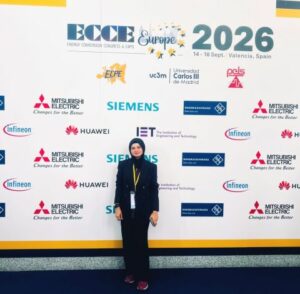 The modular multilevel converter (MMC) is a popular and advanced converter topology in the current literature. Its promising features, like modularity, scalability, and high-power quality, make it suitable to use in high-voltage DC transmission (HVDC) applications. While the modular multilevel converters are beneficial, they face challenges, like unbalanced capacitor voltages, circulating currents and high switching losses with the implementation of high-frequency modulation techniques. The conventional pulse width modulation (PWM) technique uses high-switching frequency in the kilohertz range, resulting in higher switching losses and harmonics. The research presented here proposes an enhanced low-frequency sinusoidal phase-shifted carrier pulse-width modulation (PSC-PWM) control strategy that uses only a 50 Hz switching frequency in a two-terminal MMC-HVDC system, ultimately reducing switching power losses and improving power quality. A MATLAB/Simulink-based aggregate model of a modular multilevel converter-based two-terminal HVDC system is designed to address and improve these issues. This practical and efficient 50 Hz switching frequency approach provides reduced total harmonic distortions (THD) of 0.79% for voltage and 0.5% for current, low circulating currents limited to 5% of rated current, improved DC grid voltage stability maintaining 135 kV, and fast dynamic settling times of less than 60 ms for both balanced and unbalanced grid conditions.
Many thanks to the ECCE Europe’s organising committee for creating such an excellent platform for knowledge sharing and collaboration. Both doctoral candidates are excited to have presented their research, funded by the Horizon Europe MSCA project Inter-oPEn, on the international stage. They look forward to building on the discussions and insights gained at this inspiring conference!