 |
 |
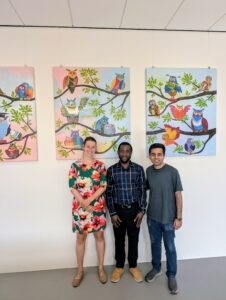
From 1 April to 30 June 2026, I carried out an academic secondment at the University of Groningen as part of the Inter-oPEn doctoral network. The secondment was hosted by the Groningen Centre of Energy Law and Sustainability (GCELS), where I worked under the supervision of Prof. Ceciel Nieuwenhout.
 The purpose of this secondment was to integrate legal and regulatory perspectives into my technical research on multi-vendor interoperability in HVDC grids. Within Inter-oPEn, my work focuses on developing and validating interoperability testing procedures for grid-connected converters. The secondment provided a complementary viewpoint on how such procedures are defined, governed, and operationalised in practice. In particular, the research investigated the legal implications of the use of simplified test envelopes for pre-qualification and qualification, and the question of responsibility for performing and validating such tests.
This secondment is directly relevant to my broader research objectives, which aim to support the transition toward power systems increasingly dominated by power electronic converters, replacing the traditional role of synchronous machines. A central challenge in this transition is ensuring interoperability across multiple vendors at both transmission and distribution levels. The work at GCELS contributed to this goal by examining the intersection of technology, standardisation, grid codes, and verification methodologies, with particular emphasis on designing collaborative and legally robust workflows that enable the safe and scalable integration of new assets into evolving HVDC grid infrastructures.
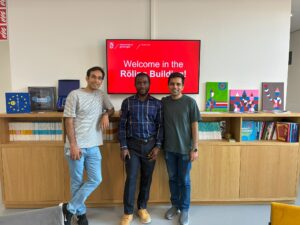 During this secondment, I engaged in several academic activities. A key activity was completing a course on Intellectual Property Law in the EU, which provided relevant insights into legal frameworks for innovation and knowledge sharing. I also co-presented my work with three fellow Inter-oPEn doctoral candidates (Ali Sajjadi, Mohammadtaher Azampour , and Donia Ayari) to the GCELS “North Sea researchers group”, receiving valuable interdisciplinary feedback on the legal and regulatory aspects. Throughout the secondment, I participated in monthly “North Sea researchers group” meetings, gaining exposure to ongoing research in energy law and governance, and attended the GCELS conference “Contested Transitions: Law for Energy Justice”, which provided additional networking and interdisciplinary exchange.
Overall, the secondment was a highly valuable experience that allowed me to move beyond the purely technical aspects of HVDC interoperability and engage with the legal and regulatory frameworks that shape system design and implementation. It reinforced that interoperability is not only a technical challenge, but also a legal problem. It strengthened the link between my research on improving and simplifying testing procedures and key issues such as standardisation, IP constraints, and accountability in testing methodologies, particularly by simplified test envelopes. It also improved my ability to communicate technical work in an interdisciplinary setting and engage with legal and policy researchers. I gained a better understanding of EU intellectual property law and developed stronger interdisciplinary communication and analytical abilities.
Written by Cham Kpu Gerald.