
 |
 |
My academic secondment was hosted at KU Leuven, where I worked with the ELECTA group and the Etch-EnergyVille team. The main purpose was to deepen my understanding of HVDC grid protection, in particular for the functional modelling in my work, and to advance my PhD on applying Model-Based Systems Engineering to the development of HVDC grid protection. The secondment lasted three months, from 1 March to the end of May 2026, during which I worked closely with the Etch protection team led by Dr. Geraint Chaffey, my academic secondment supervisor.
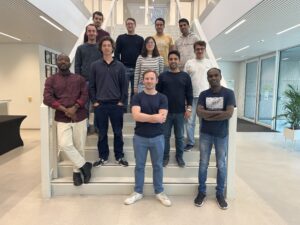 During the secondment, I had many opportunities to discuss the technical aspects of HVDC grid control and protection with the group, which brings together a number of researchers working on these topics. These discussions gave me a broader view of the field and helped me look at the problems in my own work from new angles. I also took part in the Etch protection group meetings, which gave me a good understanding of the topics the team works on and the way they approach them. The group was welcoming and supportive throughout, and the open, collaborative environment made the three months both productive and enjoyable.
A central part of my work during the secondment was developing the idea of combining Model-Based Systems Engineering and Model-Based Design into a single framework for HVDC grid protection, in which the descriptive model and the analytical design modules are coupled so that information flows both ways and the development stays traceable throughout. Developing protection in this more structured and transparent way is an important step toward interoperability in future multi-terminal, multi-vendor HVDC grids, one of the central aims of the Inter-oPEn project, the Horizon Europe MSCA doctoral network within which the secondment was carried out.
As a first use case of this framework, we connected a design module developed at KU Leuven with the MBSE model developed at TU Braunschweig, so that the module’s results could feed directly into the protection design. This was carried out together with the group and is one of the concrete outcomes of the collaboration.
I also had the chance to present my work on applying MBSE to HVDC grid protection on several occasions: in team meetings, at the Etch seminar, and at an HVDC colloquium held at KU Leuven. These gave me valuable feedback from experienced researchers on both the advantages and the challenges of the approach, and were also a good opportunity to meet others working in the field.
The secondment was a valuable experience for both my research and my development as a researcher. Beyond the technical side, it gave me a better sense of how research is carried out and how to deal with challenges that comes with it. Several of the ideas that came out of this time are now part of the work I am continuing at TU Braunschweig, and the collaboration has carried on beyond the secondment.
Overall, it was an important step that broadened my perspective and strengthened the way I approach HVDC grid protection, and I expect it to have a lasting impact on the rest of my PhD and the path I take afterwards.
Written by Abdolhamid Farshadi