
 |
 |
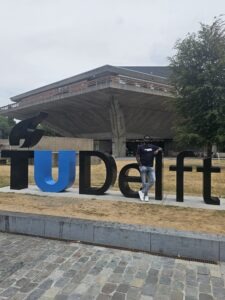
From 1 May to 31 July 2026, I completed a three-month academic secondment at Delft University of Technology (TU Delft) as part of the Inter-oPEn project, funded under the Horizon Europe Marie Skłodowska-Curie Doctoral Network. The secondment took place within the chair of Intelligent Electrical Power Grids, led by Professor Peter Palensky, and was hosted by Associate Professor Aleksandra Lekic. The main purpose of the academic secondment is to strengthen my research on impedance-based DC-side stability assessment of HVDC systems through new modelling and control approaches developed in collaboration with TU Delft.
The secondment activities were aligned with my PhD research at RWTH Aachen University, which focuses on impedance-based stability assessment of multi-vendor HVDC systems under partial control openness. Before the secondment began, I defined clear research objectives to guide my activities at TU Delft and to achieve the planned outcomes of the research exchange. Immediately after arriving at TU Delft, I joined a quarterly research group meeting, where I presented my research and became familiar with the group’s activities.
 A valuable aspect of the secondment was the collaborative research environment. I had several technical discussions with Dr Arjita Pal and my Inter-oPEn colleague, Badzlin Hashfi, on grid-forming HVDC converter modelling and control. These discussions supported my research, helped me address technical challenges, and developed into an ongoing collaboration on the DC-side stability characterisation of offshore-wind-farm-based grid-forming HVDC systems. I also had the opportunity to reconnect with Dr Victor Reyes Dreke, whom I had previously met at the HVDC Colloquium at KU Leuven. I met regularly with Associate Professor Aleksandra Lekic to review progress, discuss technical challenges, and define the next research steps. Monthly meetings with both my host supervisor and my home supervisor also ensured alignment between the secondment activities and my overall PhD objectives.
The secondment advanced my PhD research goal through two main objectives. One main outcome was the development of a grid-forming point-to-point HVDC baseline model, providing a platform to investigate the DC-side stability characteristics of grid-forming HVDC systems. Building on this model, I extended my existing DC-side impedance-scanning framework from a single-input, single-output formulation to a multiple-input, multiple-output framework. This development enables the investigation of coupled multi-port interactions using generalised Nyquist stability assessment.
In parallel, I developed an analytical harmonic-transfer-function impedance representation for the DC side of a grid-following modular multilevel converter. Initial comparisons with electromagnetic-transient impedance scans showed relevant agreement in the main frequency-dependent trends and identified important directions for further refinement. The analytical framework will be improved by incorporating additional converter dynamics and subsequently extended to grid-forming HVDC systems.
The secondment also broadened my international research network. In addition to the collaboration established with researchers at TU Delft, I initiated a collaboration with colleagues at KU Leuven to investigate the interaction between DC fault-current-limiting strategies and DC-side stability. These collaborations have created opportunities for future joint publications and continued scientific exchange within the Inter-oPEn network.
Beyond research, my stay at TU Delft was a valuable personal and professional experience. I participated in activities organised by the chair of IEPG, including the Family and Friends Summer Barbecue and the Chair Sports event. These activities provided opportunities to meet researchers from different groups, exchange ideas beyond my immediate research area, and experience the welcoming and collaborative culture at TU Delft.
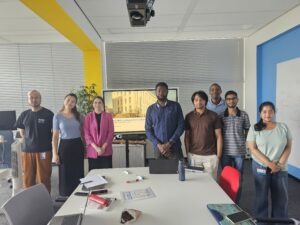
During the final week of the secondment, I presented the research outcomes achieved during my stay to the TU Delft research team. The presentation highlighted the progress made over the three months and showed how TU Delft’s expertise, guidance, and collaborative environment improved my research and collaboration skills.
The academic secondment strengthened my technical expertise in HVDC converter modelling and control, expanded my international research collaborations, and provided a foundation for the next stages of my PhD.
Written By Musa Mathew