
 |
 |
The hosting institution of my academic secondment was KTH Royal Institute of Technology, Sweden, where I worked at the Department of Electric Power and Energy Systems. The duration of the secondment was three months from December 1st, 2025 until March 1st, 2026. The purpose of my secondment at KTH Royal Institute of Technology was to gain practical experience in the design and development of the Intelligent Electronic Device (IED) product. During this period, I did several practical engineering tasks, including programming using Vivado and Xilinx SDK on Zedboard FPGA, designing printed circuit boards (PCBs) for ADC and digital circuits, and testing and validating the intended functionality of the device.
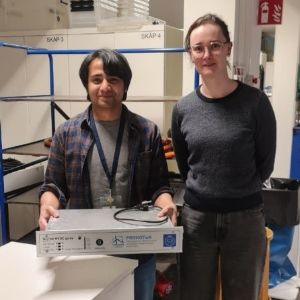 This secondment is directly relevant to my PhD research because the developed IED will be integrated into my power-hardware-in-the-loop (PHIL) experimental platform. My planned setup consists of a modular multilevel converter (MMC) hardware prototype, a power amplifier, and an RTDS-based real-time simulation environment in which a virtual multi-terminal DC (MTDC) network is implemented. Within this context, the IED will support protection, monitoring, and control functions in a more realistic experimental environment. During the secondment, I worked on practical project-oriented tasks related to the IED design, such as understanding its functional requirements, how the logic and structure needed for protection and monitoring applications, and examining how the device can be interfaced with real-time simulation and laboratory hardware. Through this activity, the secondment contributes directly to my research objectives by strengthening the practical implementation of the PHIL platform and enabling more realistic validation of converter-based power system operation, protection, and interoperability where it aligns with the objectives of the Inter-oPEn project, a Horizon Europe MSCA doctoral network that focuses on interoperability of power-electronic assets in modern power networks.
The work environment at KTH was highly collaborative. It provided a strong balance between academic research and practical engineering development, which was particularly beneficial for my research work. This collaborative environment was supported through regular discussion with supervisor, working group with other researchers, knowledge sharing and exchanges on ongoing research and challenges. These activities help me understand better how academic ideas are implemented into practical project development.
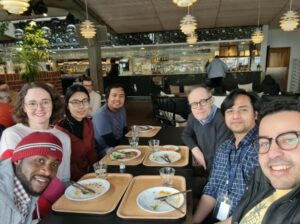 The secondment at KTH Royal Institute of Technology was a very meaningful experience for both my academic and personal development. In addition to gaining valuable knowledge in IED design and its relevance to power-hardware-in-the-loop research, I also had the opportunity to live and work in Sweden during the winter period. Experiencing the Swedish winter made the secondment especially memorable and helped me grow personally by adapting to a new environment, culture, and working atmosphere.
Professionally, the secondment strengthened my understanding of how theoretical research can be connected to practical engineering implementation. It also enhanced my skills in product design, system integration, solving technical problems, and collaboration within academic environment. This experience has had a positive impact on both my current PhD research and my future career development.